

| 일 | 월 | 화 | 수 | 목 | 금 | 토 |
|---|---|---|---|---|---|---|
| 1 | 2 | 3 | ||||
| 4 | 5 | 6 | 7 | 8 | 9 | 10 |
| 11 | 12 | 13 | 14 | 15 | 16 | 17 |
| 18 | 19 | 20 | 21 | 22 | 23 | 24 |
| 25 | 26 | 27 | 28 | 29 | 30 | 31 |
- 자동매매
- fep개발
- dma hft
- hft programming
- korea inbound
- system trading
- dma development
- 프랍데스크
- DMA개발
- kernel bypass
- KRX HFT
- futures options
- nic offload
- 저지연시스템
- 주문fep
- HFT system
- high frequency trading
- trading engineering
- mmlp
- hft tuning
- 시스템 트레이딩
- 트레이딩 엔지니어링
- speed trading
- algo trading
- low latency
- hft개발
- dma fep
- 주문 오더북
- ultra low latency
- Korea dma
- Today
- Total
Fontes Fintech
Why Kernel Bypass and User-Space Networking Matter in Low-Latency Trading Systems | Trading Engineering — Deep Dive #8 본문
Why Kernel Bypass and User-Space Networking Matter in Low-Latency Trading Systems | Trading Engineering — Deep Dive #8
폰테스 핀테크 :: 금융거래의 안전한 미래 2026. 10. 1. 00:59Why Kernel Bypass and User-Space Networking Matter in Low-Latency Trading Systems
Trading Engineering — Deep Dive #8
Introduction
In the previous articles, we looked at CPU Cache, False Sharing, CPU Affinity, NUMA, Polling, Interrupts, and NIC architecture.
All of these topics eventually lead to one important question:
How much of the network processing path does our application actually control?
In a traditional Linux networking architecture, packets travel through several layers:
NIC → Driver → Kernel → Network Stack → Socket → Application
This architecture is flexible, reliable, and suitable for general-purpose applications.
However, in latency-sensitive trading systems, every layer in the packet path can become part of the latency budget.
This is where Kernel Bypass and User-Space Networking become important.
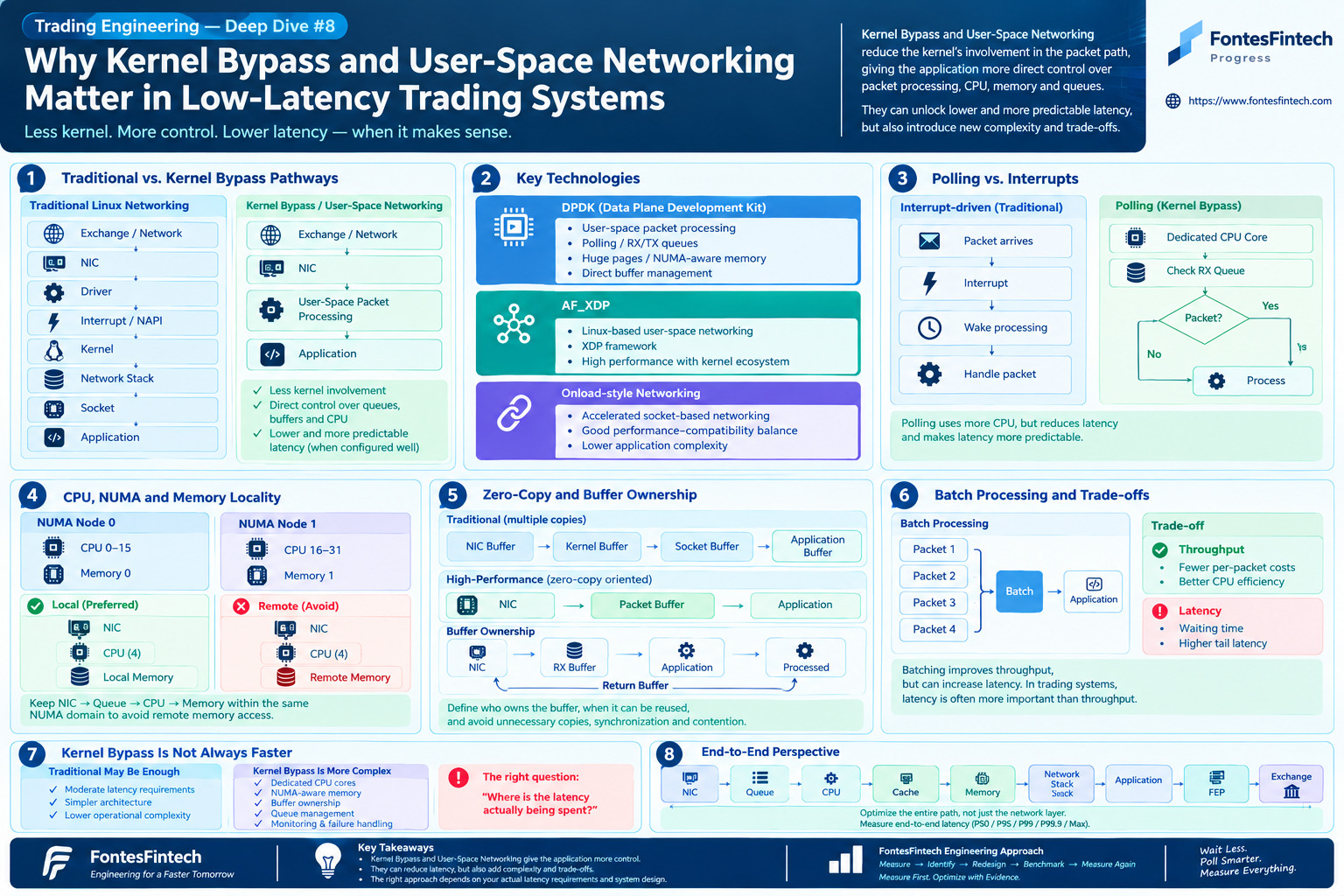
1. The Traditional Linux Networking Path
A simplified packet receive path looks like this:
Exchange
   ↓
Network
   ↓
NIC
   ↓
NIC Driver
   ↓
Interrupt / NAPI
   ↓
Linux Kernel
   ↓
Network Stack
   ↓
Socket
   ↓
Application
Each layer provides important functionality.
The Linux kernel handles:
- Network protocols
- Socket management
- Buffer management
- Scheduling
- Interrupt processing
- Memory management
- Security and isolation
For most applications, this is exactly what we want.
The problem is that a low-latency trading system may only need a small subset of this functionality.
2. Why Does the Kernel Become a Concern?
The Linux networking stack is designed as a general-purpose system.
That means it needs to support many different workloads and provide strong abstractions.
For a latency-sensitive trading application, however, some of those abstractions can introduce additional processing.
For example:
Packet
  ↓
Interrupt
  ↓
NAPI
  ↓
Kernel Network Stack
  ↓
Socket Buffer
  ↓
Application
Every additional processing stage can potentially contribute to:
- CPU cycles
- Memory access
- Cache activity
- Buffer management
- Context transitions
- Scheduling effects
- Queueing
- Latency variation
The important point is not that the Linux kernel is "slow."
The real question is:
How much of the latency is actually being spent in the networking path?
3. What Is Kernel Bypass?
Kernel Bypass generally means reducing or avoiding the traditional kernel networking path for latency-sensitive packet processing.
Instead of:
NIC
 ↓
Kernel
 ↓
Socket
 ↓
Application
a system may use a path closer to:
NIC
 ↓
User-Space Networking
 ↓
Application
The goal is to reduce unnecessary work between packet arrival and application processing.
However, Kernel Bypass does not mean that the operating system kernel disappears.
The kernel may still be responsible for:
- Process management
- Memory management
- Device initialization
- System administration
- Control-plane operations
- Other applications and services
The idea is to minimize kernel involvement specifically in the latency-critical data path.
4. What Is User-Space Networking?
User-Space Networking moves part of the packet-processing workload from the kernel into user space.
A simplified architecture is:
             Traditional
NIC → Kernel → Socket → Application


             User-Space Networking
NIC → User Space Packet Processing → Application
This gives the application more direct control over:
- Packet buffers
- RX/TX queues
- Polling
- Memory allocation
- CPU placement
- Batch processing
- Packet ownership
This can significantly change the architecture of a low-latency system.
But it also increases the responsibility of the application.
5. DPDK
One of the most widely known technologies in this area is DPDK (Data Plane Development Kit).
DPDK provides a framework for high-performance packet processing in user space.
A typical design may look like:
NIC
 ↓
RX Queue
 ↓
DPDK Polling
 ↓
Packet Buffer
 ↓
Application
 ↓
TX Queue
 ↓
NIC
Depending on the NIC, driver and configuration, DPDK can provide mechanisms such as:
- User-space packet processing
- Polling
- Dedicated CPU cores
- Huge pages
- NUMA-aware memory allocation
- RX/TX queues
- Batch packet processing
- Direct packet-buffer management
The important concept is that the application gains much greater control over the packet-processing path.
6. Polling
Kernel Bypass systems commonly use polling rather than relying entirely on interrupts.
Instead of:
Packet arrives
      ↓
Interrupt
      ↓
Wake processing
      ↓
Handle packet
a dedicated CPU may continuously check:
CPU Core
   ↓
Check RX Queue
   ↓
Packet?
   ├── No → Check Again
   └── Yes → Process
This consumes CPU continuously.
But for a dedicated low-latency trading core, that may be an intentional trade-off.
The objective is not:
Minimize CPU utilization.
It is:
Minimize latency and make latency more predictable.
7. CPU Affinity and Core Pinning
Kernel Bypass does not automatically solve CPU scheduling problems.
A user-space networking application still needs to consider where its threads execute.
For example:
NIC RX Queue 0
       ↓
     CPU 4
       ↓
Market Data Thread
       ↓
Strategy
A carefully designed system may assign dedicated cores to specific functions.
For example:
CPU 4 → Market Data
CPU 5 → Strategy
CPU 6 → Risk Check
CPU 7 → Order Management
This can help reduce:
- Thread migration
- Cache disruption
- Scheduling interference
- Unpredictable execution
This is why Kernel Bypass is closely connected to CPU Affinity.
8. NUMA and Memory Locality
CPU placement alone is not enough on a multi-socket server.
Consider:
NUMA Node 0
CPU 0-15
Memory 0

NUMA Node 1
CPU 16-31
Memory 1
If a trading thread runs on CPU 4 but repeatedly accesses memory located on Node 1, the application may experience remote memory access.
A better architecture is:
NIC
 ↓
CPU 4
 ↓
Local Memory
rather than:
NIC
 ↓
CPU 4
 ↓
Remote NUMA Memory
Therefore, Kernel Bypass systems often require careful coordination of:
NIC → Queue → CPU → Memory
This is one reason NUMA-aware design is so important in high-performance networking.
9. Zero-Copy and Memory Copy
Another important concept is reducing unnecessary memory movement.
A traditional path may involve several buffers:
NIC Buffer
   ↓
Kernel Buffer
   ↓
Socket Buffer
   ↓
Application Buffer
Depending on the architecture, data may be copied or transformed between different buffers.
A high-performance design attempts to reduce unnecessary movement:
NIC
 ↓
Packet Buffer
 ↓
Application
This is often described as zero-copy or zero-copy-oriented design.
However, "zero-copy" should not be interpreted literally as "no data ever moves."
It is better understood as:
Avoid unnecessary memory copies in the critical data path.
Memory bandwidth, cache locality, buffer ownership and synchronization still matter.
10. Packet Buffer Ownership
Once packet processing moves closer to user space, buffer ownership becomes an important design issue.
For example:
NIC
 ↓
RX Buffer
 ↓
Application
 ↓
Processed
 ↓
Return Buffer
The system needs to define:
- Who owns the buffer?
- When can the NIC reuse it?
- When can the application modify it?
- When can it be returned to the pool?
Poor buffer ownership management can introduce:
- Synchronization
- Memory contention
- Additional copies
- Cache invalidation
- Race conditions
Therefore, packet-buffer management becomes part of application architecture.
11. Batch Processing
High-performance networking systems often process multiple packets together.
For example:
Packet 1
Packet 2
Packet 3
Packet 4
      ↓
Batch Processing
      ↓
Application
Batching can reduce per-packet overhead and improve CPU efficiency.
However, there is an important trade-off.
If the system waits to accumulate a batch:
Packet 1 arrives
       ↓
Wait
       ↓
Packet 2 arrives
       ↓
Wait
       ↓
Process batch
the waiting time itself can increase latency.
Therefore:
Batching can improve throughput while potentially increasing latency.
This distinction is extremely important in trading systems.
12. Kernel Bypass Is Not Always Faster
This is perhaps the most important point of this article.
Kernel Bypass is not automatically faster.
A system can become more complicated without becoming faster.
For example:
Traditional Networking

NIC
 ↓
Kernel
 ↓
Socket
 ↓
Application
may be perfectly adequate for an application whose latency requirements are moderate.
Meanwhile:
Kernel Bypass

NIC
 ↓
User-Space Driver
 ↓
Polling
 ↓
Packet Buffer
 ↓
Application
may require significant engineering effort.
It can introduce new concerns:
- Dedicated CPU consumption
- Memory management
- Buffer ownership
- NUMA configuration
- Queue management
- Monitoring
- Failure handling
- Operational complexity
Therefore, the right question is not:
"Can we use Kernel Bypass?"
It is:
"Where is the latency actually being spent?"
13. Kernel Networking vs Kernel Bypass
AreaKernel NetworkingKernel Bypass / User Space
| Network Stack | Kernel | User-space oriented |
| Socket API | Common | Depends on framework |
| CPU Usage | Generally efficient | Often higher |
| Polling | Optional | Common |
| Buffer Control | Kernel-managed | Application-controlled |
| NUMA Control | Important | Very important |
| Complexity | Lower | Higher |
| Latency Control | More indirect | More direct |
| Flexibility | High | Application-specific |
| Engineering Cost | Lower | Higher |
Neither architecture is universally correct.
The appropriate choice depends on the actual latency requirement and system design.
14. Representative Approaches
Several technologies can be used for high-performance networking.
DPDK
Provides a framework for high-performance packet processing in user space.
Commonly associated with:
- Polling
- RX/TX queues
- Huge pages
- NUMA-aware memory
- Packet-buffer management
AF_XDP
A Linux interface designed for high-performance packet processing using the XDP framework.
It provides a way to move packet processing closer to user space while remaining within the Linux ecosystem.
Onload-style Networking
Some networking technologies accelerate applications while retaining familiar socket-based programming models.
This can provide a different trade-off between:
Performance ↔ Compatibility ↔ Application Complexity
The exact architecture depends on the technology and deployment configuration.
15. Applying Kernel Bypass to Trading Systems
Consider a market-data system.
A conventional architecture might be:
Exchange
   ↓
Network
   ↓
NIC
   ↓
Kernel
   ↓
Socket
   ↓
Market Data Handler
   ↓
Order Book
   ↓
Strategy
A low-latency architecture may instead attempt:
Exchange
   ↓
Network
   ↓
NIC
   ↓
User-Space Packet Processing
   ↓
Market Data Handler
   ↓
Order Book
   ↓
Strategy
The difference is not simply "Kernel vs No Kernel."
The real difference is:
How much control does the application have over the critical packet-processing path?
16. DMA and Kernel Bypass
DMA and Kernel Bypass are closely related concepts, but they are not the same thing.
DMA is a hardware mechanism for transferring data between devices and memory with limited CPU involvement.
Kernel Bypass is an architectural approach that reduces the involvement of the operating-system kernel in the data path.
For example:
DMA
Device → Memory
describes how data moves.
While:
NIC → User-Space Packet Processing → Applicationdescribes where packet processing takes place.
A high-performance networking system can use both.
17. Does Every DMA Trading System Need Kernel Bypass?
No.
This is an important practical consideration.
A DMA trading system may already achieve sufficient performance using:
- Efficient Linux networking
- CPU Affinity
- NUMA-aware design
- NIC queue tuning
- Interrupt affinity
- Busy Polling
- Memory optimization
- Reduced copying
- Efficient application architecture
Kernel Bypass should be considered when the remaining latency or latency variation justifies the additional complexity.
18. End-to-End Latency
Optimizing only the network layer is not enough.
Consider:
NIC
 ↓
Queue
 ↓
CPU
 ↓
Cache
 ↓
Memory
 ↓
Packet Processing
 ↓
Order Book
 ↓
Strategy
 ↓
Risk Check
 ↓
Order Manager
 ↓
FEP
 ↓
Exchange
Even if the NIC-to-application path is extremely fast, another component can dominate the total latency.
For example:
- Cache miss
- NUMA remote access
- Memory copy
- Lock contention
- Thread migration
- Context switching
- Queueing
- Strategy execution
can all become larger contributors.
This is why we should always measure end-to-end latency, not just network latency.
19. The Bigger Picture
The topics covered in the Deep Dive series are closely connected:
CPU Cache
   ↓
False Sharing
   ↓
CPU Affinity
   ↓
NUMA
   ↓
epoll / Busy Polling
   ↓
Interrupt / NAPI
   ↓
NIC
   ↓
Kernel Networking
   ↓
Kernel Bypass
These are not isolated optimization techniques.
They are different layers of the same system.
A low-latency trading system needs to consider the entire path:
NIC → CPU → Cache → Memory → Network Stack → Application → FEP → Exchange
20. FontesFintech Engineering Approach
At FontesFintech, we do not assume that a particular technology is always the fastest.
Instead, we start with a question:
Where is the latency actually being spent?
Then we follow a repeatable process:
Measure → Identify → Redesign → Benchmark → Measure Again
For some systems, optimized kernel networking may be sufficient.
For others, busy polling or user-space networking may provide meaningful improvements.
The important thing is to make the architecture decision based on measured system behavior rather than technology preference.
Conclusion
Kernel Bypass and User-Space Networking can provide powerful tools for building low-latency trading systems.
But they are not magic solutions.
They introduce greater control over:
- Packet processing
- CPU utilization
- Memory management
- NUMA locality
- Packet buffers
- Queue processing
- Polling
- Data movement
At the same time, they introduce additional engineering complexity.
The key question is therefore not:
"How can we bypass the kernel?"
It is:
"Why should we bypass the kernel, and what latency problem are we trying to solve?"
In low-latency trading systems, optimization should always begin with measurement.
Measure First. Optimize with Evidence.
Next: Trading Engineering — Deep Dive #9
TCP vs UDP for Low-Latency Trading Systems
We will examine how TCP and UDP differ in reliability, ordering, retransmission, congestion control, multicast, and latency — and why "UDP is faster" is far too simple a conclusion for a real trading system.


